You’ve heard the arguments at every tailgate, bar crawl, and backyard cookout. The beer drinker swears their choice is more “natural,” more filling, easier to pace. The whiskey or tequila drinker fires back that a single shot gets the job done without all the bloat. And somewhere in the middle, the cocktail lover insists that what’s in your glass matters far less than how you drink it.
- Does Michelob Ultra Have Gluten Updated 10/2026
- Who Is The Heineken Actor Beer Commercial? Updated 10/2026
- How To Boil Brats Without Beer Updated 10/2026
- Beer Can Chicken Without Stand Updated 10/2026
- Can You Mix Beer And Wine? Here’s What Science, Bartenders, and Your Next Hangover All Agree On Updated 10/2026
So who’s right? Is beer genuinely better than liquor? Or is this one of those classic American bar debates with no clean answer?
You Are Watching: Is Beer Better Than Liquor Updated 10/2026
The short version: it’s complicated, and it depends on what you mean by “better.” Better for your liver? Better for your waistline? Better for your bones? Better at giving you a brutal hangover? Each category produces a different winner, and the research behind all of it is far more interesting than most people realize.
This is the full breakdown — the nutrition, the biology, the hangover science, the bone health data, and yes, the American drinking culture that shapes all of it. Grab whatever you’re drinking, because this is going to take a minute.
What You’re Actually Comparing: ABV, Standard Drinks, and Why the Playing Field Matters
Before anything else makes sense, you need to understand how alcohol is measured. Alcohol by volume (ABV) is the percentage of a beverage that is pure ethanol, and it varies dramatically between beer and liquor.
A standard American lager — your Bud Light, Coors, or Miller Lite — sits around 4.2% ABV. A craft IPA or a double stout can push anywhere from 7% to 12% ABV. Hard liquor, by contrast, is typically 40% ABV (or 80 proof), with some premium whiskeys and overproof rums pushing above 50%.
The U.S. Centers for Disease Control and Prevention defines a standard drink as containing roughly 14 grams of pure ethanol. In practical terms, that looks like:
- 12 oz of regular beer at 5% ABV
- 5 oz of wine at 12% ABV
- 1.5 oz of distilled spirits at 40% ABV
This is where most comparisons go sideways. People assume that because beer has a lower ABV, it’s automatically the safer or healthier choice. But a person slamming back four IPAs at a craft brewery has consumed significantly more alcohol than someone nursing two neat pours of bourbon over the same two hours. The container doesn’t determine the dose — the content and quantity do.
Beer is often consumed in larger quantities, which exposes drinkers to more total alcohol than they might expect. That’s a reality worth keeping front and center before making any sweeping declarations about one being “safer” than the other.
Calories and Nutrition: The Real Numbers Side by Side
For Americans who are weight-conscious, calorie-aware, or simply trying to be more intentional about what goes into their bodies, this is often the first question. And the answer is more nuanced than the “beer belly” stereotype suggests.
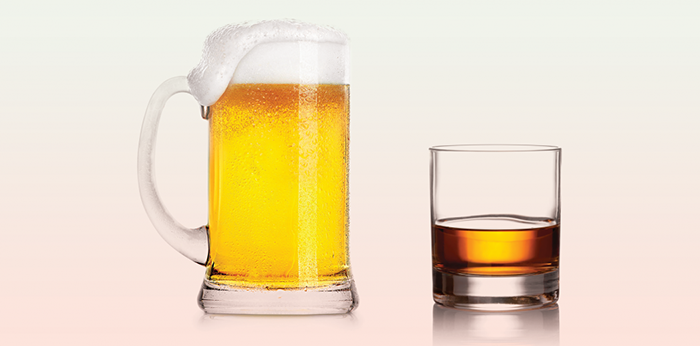
A 12-ounce glass of beer has about 150 calories, a 5-ounce glass of red wine has about 125 calories, and a 1.5-ounce shot of gin, rum, vodka, whiskey, or tequila has about 100 calories, according to the National Institute on Alcohol Abuse and Alcoholism.
At first glance, liquor wins the calorie game per serving. But that’s only if you’re doing a straight, unaccompanied shot. The moment you mix it into a cocktail, the numbers shift dramatically.
A mixed drink with an unflavored liquor and a sweetened soda or tonic water — like a vodka tonic — will contain 150 calories and 13.5 grams of sugar. And that’s one of the lighter cocktails. Long Island Iced Teas and frozen margaritas can push past 700 calories per glass.
On the beer side, the range is enormous. Light lagers from major domestic breweries clock in around 90 to 110 calories per 12 oz. But many restaurants and bars serve beer in pints, which are 16 oz, and craft beers often contain more calories than commercial beers. A 16 oz pour of a 7% craft IPA can easily land at 250 to 300 calories before you’ve touched a single chip from the basket on the table.
Here’s a practical comparison to anchor the numbers:
| Drink | Serving Size | Approx. Calories | Carbs | ABV |
|---|---|---|---|---|
| Light Lager (e.g., Bud Light) | 12 oz | 110 | 6.6g | 4.2% |
| Regular Lager (e.g., Budweiser) | 12 oz | 145 | 10.6g | 5.0% |
| Craft IPA | 12 oz | 200–250 | 15–20g | 6–8% |
| Dark Stout (e.g., Guinness) | 12 oz | 126 | 10g | 4.2% |
| Vodka (neat) | 1.5 oz | 97 | 0g | 40% |
| Whiskey (neat) | 1.5 oz | 105 | 0g | 40% |
| Vodka Soda | 8 oz mixed | ~100 | 0g | varies |
| Margarita (restaurant) | 8 oz | 300–450 | 30–45g | varies |
| Gin & Tonic | 8 oz | ~150 | 14g | varies |
| Rum & Coke | 8 oz | ~185 | 20g | varies |
The takeaway here isn’t that one category wins clean. Beer tends to be higher in carbohydrates and calories than wine or spirits, which makes it a potentially less ideal choice for people watching their blood sugar or weight — especially when drinking pints or higher-alcohol craft beers. However, a straight spirit mixed with club soda is often one of the lowest-calorie ways to drink alcohol, while a premium cocktail can rival a full meal.
The honest rule of thumb: what you mix into your liquor matters as much as the liquor itself, and what style of beer you choose matters enormously for your calorie budget.
What Beer Has That Liquor Simply Doesn’t
Nutritionally, beer actually holds a surprising edge over distilled spirits in one specific area: micronutrients. This is not a reason to start drinking more beer, but it is a meaningful distinction.
Unlike many other alcoholic beverages, beer contains B vitamins (especially B6), magnesium, potassium, and phosphorus. Dark beers such as stouts and porters have higher levels of antioxidants, which help combat oxidative stress and cellular damage. The hops in beer contain flavonoids like xanthohumol, which have anti-inflammatory and antimicrobial properties.
Distilled spirits, by contrast, are stripped of nearly all non-alcoholic compounds during the distillation process. All of hard liquor’s calories come from its alcohol (40% to 50%), and it has no sugar and essentially no micronutrients.
This doesn’t make beer a health food. It does mean that if you’re going to drink alcohol anyway, beer delivers at least something alongside the ethanol — where a shot of vodka delivers almost nothing but the ethanol itself.
The Hangover Question: Why You Feel Like Death, and Who’s Responsible
Arguably the most universally relatable part of this entire debate. Hangovers affect every drinker eventually, and the type of alcohol you consume plays a very real role in how badly your morning goes.
The key concept here is congeners. These are chemical byproducts produced during fermentation and aging — compounds like acetaldehyde, acetone, tannins, and various fusel alcohols. They give aged spirits and dark beers their complex, distinctive flavors, but they also significantly worsen hangovers.
Darker-colored drinks like bourbon, rum, and red wine contain higher amounts of congeners than clear liquors like vodka. Some studies have shown that beverages with more congeners can result in a more severe hangover.
Read More : Best Beer For Sake Bombs Updated 10/2026
This explains the well-known drinker’s observation that a night of bourbon or dark rum tends to produce a far more brutal morning than an equivalent night of vodka sodas. It’s not just folk wisdom — there’s genuine biochemistry behind it.
Clear liquor options like vodka may leave you with a clearer head the next day, while darker liquors like bourbon gain color and taste from impurities known as congeners, which appear to lead to a particularly wicked hangover.
Beer occupies interesting middle ground in this context. Most standard lagers and light beers have relatively low congener content — lower than bourbon or dark rum. However, certain craft beers, especially heavily hopped IPAs, dark stouts, and barrel-aged ales, can carry significant congener loads.
A hangover almost always means you are completely dehydrated, with depleted vitamins — typically Vitamin A, B, and C — and accumulated acetaldehyde, a toxic byproduct of your body metabolizing alcohol. Acetaldehyde is responsible for headaches, nausea, increased heart rate, and flushed faces.
The practical hierarchy for minimizing next-morning misery, from best to worst, looks roughly like this:
- Clear spirits (vodka, gin) mixed with non-sugary mixers
- Light beer and standard domestic lagers
- Craft IPAs and pale ales
- Dark beers (stouts, porters)
- Wine (especially red)
- Whiskey, bourbon, dark rum, aged tequila
- Mixed cocktails with multiple sugary mixers
The Liver: What Happens When Alcohol Hits Your Most Overworked Organ
This is where things get genuinely serious, and where the “which is worse” question gets a concrete answer, at least in one dimension.
No matter which drink you consume, alcohol is absorbed into your bloodstream and passes through your liver for detoxification. However, alcohol is toxic to the liver, which means that prolonged alcohol abuse, regardless of your drink of choice, can damage this vital organ.
Your liver can process approximately one standard drink per hour. Everything beyond that spills into the bloodstream as active intoxication. This is why the rate of consumption matters so much. Beer’s slower natural pace — sipping a bottle or pint over 30 to 60 minutes — tends to keep most social drinkers within a manageable processing window for the liver.
Liquor, however, changes the equation significantly.
It takes much less hard liquor to cause the same effects as a mug of beer or glass of wine, leading to intoxication far quicker. People tend to down spirits more quickly, especially in shot form — multiple shots can be downed in a matter of minutes, where it usually takes beer drinkers a few hours to consume the same amount of alcohol.
This is the core argument for beer being “safer” in practical terms, and it holds up. The physical size and carbonation of beer act as natural brakes on consumption speed. Shots and cocktails don’t come with that built-in pacing mechanism.
A shot of liquor can produce stronger effects than a can of beer, and the ability to mask the strong flavor with non-alcoholic beverages can make liquor easier to abuse, particularly because pleasant taste can obscure how much alcohol is actually being consumed.
Long-term, heavy use of either form causes similar liver damage: fatty liver disease, alcoholic hepatitis, and eventually cirrhosis. But the speed at which heavy liquor use can produce acute liver damage is notably faster than equivalent beer consumption — simply because the rate of alcohol delivery to the liver is higher.
Bone Health: The Surprising Area Where Beer May Have a Real Edge
This is one of the more fascinating and counterintuitive findings in alcohol research, and it’s a genuine point in beer’s favor.
Beer is one of the richest dietary sources of bioavailable silicon, specifically as orthosilicic acid (OSA). Silicon is an essential mineral for bone formation, and it’s rarely discussed in mainstream nutrition conversations. Studies suggest that dietary silicon intake is positively associated with bone mineral density, and beers containing high levels of malted barley and hops are richest in silicon.
Researchers at the University of California, Davis analyzed 100 commercial beers and found significant silicon content across all styles, with pale ales leading the pack. The range stretched from 6.4 mg per liter on the low end to 56.5 mg per liter in some pale ales — a meaningful dietary source of a mineral that supports bone density.
A landmark study published in The American Journal of Clinical Nutrition looked at how beer, wine, and liquor intake related to bone mineral density (BMD) in older men and women:
Compared with nondrinkers, hip BMD was greater (3.4 to 4.5%) in men consuming one to two drinks per day of total alcohol or beer. In men, high liquor intakes (more than two drinks per day) were associated with significantly lower BMD. After adjustment for silicon intake, all intergroup differences for beer were no longer significant, suggesting that silicon appears to mediate the association of beer, but not wine or liquor, with bone mineral density.
That last point is significant: it wasn’t just the alcohol doing the bone-strengthening work in beer drinkers. The silicon itself was the active ingredient. And hard liquor, notably, showed the opposite pattern at high intake levels — lower bone density in men who drank spirits heavily.
Silicon has been reported to be essential for bone growth, and B-complex vitamins such as vitamin B-6, vitamin B-12, and folate are known to reduce circulating homocysteine, which has been associated with increased fracture risk. Beer contains silicon and small quantities of B vitamins, which could plausibly contribute to bone health.
This is not a reason to start drinking beer for your bones — you can get silicon from green beans, oats, and other plant foods without the alcohol. But it is a genuine nutritional distinction between beer and spirits that most people don’t know about.
Heart Health and Cardiovascular Research: A More Level Playing Field
This is an area where both beer and moderate amounts of liquor show similar associations in the epidemiological research, though the mechanism differs.
Research published in the European Journal of Epidemiology suggests that moderate beer drinkers have a 25% lower risk of cardiovascular disease than non-drinkers. Beer contains polyphenols and antioxidants that help reduce inflammation and support circulation, promoting overall vascular health.
Moderate alcohol consumption across categories — beer, wine, and spirits — has consistently shown associations with slightly lower cardiovascular risk in observational studies. The mechanism involves alcohol’s effect on HDL (“good”) cholesterol, blood thinning, and reduced clot formation. However, all of this research comes with a serious asterisk: these are associations, not proof of causation, and the picture has become considerably more complicated as newer research questions whether any level of alcohol consumption is actually cardiovascular-beneficial when confounding factors are fully controlled.
Drinking alcohol in moderation — be it beer, wine, or hard liquor — has been associated with notable potential benefits such as some protection against heart disease, stroke, or diabetes. But too much of a good thing can be bad, and when it comes to abusing alcohol, both types can cause detrimental effects in more ways than one.
The honest current state of the science: at genuinely moderate levels (one drink per day for women, two for men as defined by the CDC), both beer and spirits appear roughly equivalent in their cardiovascular associations. The type of alcohol matters less here than the amount.
Addiction, Intoxication Speed, and the “Which Gets You Hooked Faster” Reality
Because liquor enters the system more quickly, we feel its effects more quickly — from dopamine release to inhibition. Dopamine is the feel-good chemical in our brain responsible for the warm, fuzzy feeling we get when we drink; it stimulates our reward system and inspires us to drink more. Therefore, liquor tends to be more addictive than beer, but don’t be fooled: once alcohol is in our bodies, our brains don’t care whether it got there from a shot, a cocktail, or a beer.
Read More : What Does Dos Equis Mean Updated 10/2026
The speed of intoxication matters enormously for addiction risk. Hard liquor delivers a faster, sharper dopamine spike than beer, which creates a stronger reinforcement signal in the brain’s reward circuitry. This is why binge drinking culture around shots and cocktails tends to escalate faster than equivalent beer-drinking behavior.
The risk of addiction is higher with liquor due to its higher alcohol content and the rapid onset of its effects. Binge drinking is a dangerous pattern of alcohol use that can lead to serious health issues, including alcohol poisoning, liver disease, and increased risk of accidents and injuries. It is more common with liquor due to its potency, but excessive beer consumption can also result in similar risks.
Beer’s physical volume acts as a kind of natural pacing mechanism — there’s only so much liquid a stomach can hold at once. Shots don’t come with that brake. This is why, from a purely behavioral standpoint, beer tends to be consumed in a pattern more compatible with social drinking, while liquor consumption is harder to intuitively self-regulate.
That said, alcohol use disorder develops through repeated heavy use of any type of alcohol. The long-term drinker consuming a 12-pack of beer nightly is just as at risk as the person doing six shots. The delivery mechanism is different; the destination is the same.
Weight and Body Composition: The “Beer Belly” Myth vs. Cocktail Calories
The “beer belly” is one of the most persistent myths in American drinking culture. The reality is more nuanced.
Weight gain comes from excessive calorie intake, not beer alone. Drinking beer in moderation without excess food consumption or inactivity is unlikely to cause significant weight gain.
The reason beer gets blamed for weight gain has less to do with some specific property of beer and more to do with drinking behavior. Beer is frequently consumed alongside high-calorie bar food — wings, nachos, burgers. It also stimulates appetite and lowers inhibitions around eating. And yes, the carbohydrates in regular and especially craft beer add up over an evening of multiple rounds.
Liquor and cocktails have their own weight management pitfalls. A true 1.5-ounce pour without mixers is relatively low in calories, but many cocktails contain two or three ounces of liquor mixed with sugary additions. A restaurant margarita, a piña colada, or a Long Island Iced Tea can easily outpace the calories in three or four beers.
A 2012 study found that the average American adult consumes 100 calories a day from beer, wine, or other alcoholic beverages, with close to 20% of men and 6% of women consuming more than 300 calories from alcohol daily. Consuming 100 calories more than you burn every day may lead to a weight gain of 10 pounds over a year.
For weight management specifically, the most calorie-efficient approach to drinking is clear spirits with non-caloric mixers (soda water, diet tonic) or light beer. The worst approaches are premium cocktails loaded with simple syrups, juices, and cream — and craft beers consumed in large-format pints throughout an evening.
What Americans Are Actually Drinking, and How Tastes Are Shifting
Beer remains the single most popular category of alcoholic beverage in the United States by volume. In 2023, U.S. consumers aged 21 and older purchased approximately 24 gallons of beer, malt-based beverages, and cider per person. The U.S. beer industry sold about $135 billion in beer and malt-based beverages to U.S. consumers through retail beer establishments.
When asked to indicate their beverage category of choice, 30% of consumers preferred liquor, 31% wine, and 35% preferred beer. So beer holds a slight numerical lead, but the margins are closer than beer’s historic dominance would suggest.
Since 1970, the peak year for beer consumption was 1981, when the typical American age 21 or older drank 36.7 gallons annually. By 2021, beer consumption had fallen to 26.5 gallons per person. Meanwhile, wine and spirits have both gained ground in the same period.
The craft beer boom has been one of the more dramatic cultural shifts in American drinking. Of the American population in 2014, 32% drank craft beer at least several times per year. By 2024, that number reached 48% of the population. But frequency is declining as younger drinkers explore across categories — hopping between craft beer, premium spirits, canned cocktails, and hard seltzers within the same week.
The US beer market shows resilience despite rising costs and changing consumer preferences, with overall sales expected to reach $181 billion by 2030. Growth is driven by increased demand for imported and non-alcoholic beers, even as traditional domestic and craft segments decline.
Perhaps most telling: the fastest-growing segment in the alcohol industry right now isn’t any specific type of booze. It’s non-alcoholic and low-ABV alternatives, driven by a generation that wants the social experience of drinking without the full physiological cost. That cultural shift reflects exactly the kind of nuanced thinking this beer-vs-liquor debate has always deserved.
A Head-to-Head Comparison Across Every Category
| Category | Beer | Liquor | Edge |
|---|---|---|---|
| Calories per standard drink | ~150 (lager) | ~100 (straight) | Liquor (straight) |
| Calories with mixers | Moderate | Can be very high | Beer |
| Carbohydrates | Moderate to high | None (straight spirit) | Liquor |
| Micronutrients | B vitamins, silicon, antioxidants | Essentially none | Beer |
| Intoxication speed | Slower | Faster | Beer (more controlled) |
| Hangover severity (dark varieties) | Moderate | High (bourbon, dark rum) | Light beer |
| Bone health (silicon) | Yes (meaningful) | No | Beer |
| Addiction speed | Slower | Faster | Beer |
| Liver risk at equal alcohol doses | Similar | Similar (but faster delivery) | Beer (pace) |
| Weight management (smart choices) | Light beer wins | Straight spirit + soda wins | Tie |
| Social pacing | Built-in (volume) | Requires more discipline | Beer |
The One Thing Both Sides Agree On
The truth is, neither beer nor liquor is “better” than the other, but liquor seems to be especially harmful in certain high-risk scenarios. Research published in major journals consistently confirms that in terms of long-term health, how much you drink matters far more than what you drink.
In general, how much you drink is more important than the type of alcohol you choose. This is the consensus position of registered dietitians, hepatologists, and public health researchers alike.
The federal Dietary Guidelines for Americans define moderate drinking as up to one drink per day for women and up to two drinks per day for men. Alcohol is responsible for 178,000 deaths each year in the United States, due to car crashes, suicides, homicides, violence, falls, heart disease, breast cancer, liver disease, and more — across all types of alcoholic beverages combined.
So, Is Beer Better Than Liquor?
On balance, beer does hold contextual advantages over hard liquor for the average American social drinker:
Its lower ABV encourages natural pacing. Its nutritional profile includes micronutrients that spirits don’t offer. Its silicon content supports bone health in ways liquor doesn’t replicate. Its physical volume acts as a natural consumption brake. And from a public health standpoint, the acute overdose risk of beer is genuinely lower than that of straight spirits — it is very difficult to die of an overdose of 2.8% beer, but not so hard with a beverage containing 40% ethanol content.
But liquor wins on pure calories per serving, has zero carbohydrates, produces fewer congener-related hangover effects when choosing clear spirits, and can absolutely be the smarter choice for someone who orders two vodka sodas and stops there — compared to someone who drinks six IPAs across an evening.
The real answer lives not in the type of glass but in the relationship you have with what’s inside it.
Conclusion
Think about the best drink you’ve ever had. Chances are, it wasn’t defined by ABV or calorie count or silicon content — it was defined by the moment surrounding it. The cold beer at the end of a long summer hike. The whiskey neat during a winter storm. The cocktail that marked a celebration you’ll never forget.
The science gives us useful guardrails, but it doesn’t settle the bar debate, because the bar debate was never really about nutrition labels. It’s about identity, ritual, and pleasure — things that don’t belong on a comparison table.
What the research does give us is permission to be more intentional. To drink what we actually love, how it treats our bodies best, and in the amounts that let us wake up the next morning still feeling like ourselves. That’s not a restriction. That’s just drinking like an adult.
Choose your glass wisely. It doesn’t have to be the “right” one — it just has to be the right one for you.
Sources: https://chesbrewco.com
Category: Beer