Whether you’re gearing up for your first Oktoberfest celebration, shopping for a new mug, or just curious after someone handed you a massive dimpled glass at a bar, the question is totally fair: how much beer is actually in a stein? The answer depends on which stein you’re holding, where it came from, and whether you’re measuring to the fill line or the brim. This guide covers everything, from the classic half-liter you’d sip in a Munich beer garden to the thunderous one-liter “Mass” that servers carry five at a time at Oktoberfest, and everything in between.
The Short Answer: It Depends on the Stein Size
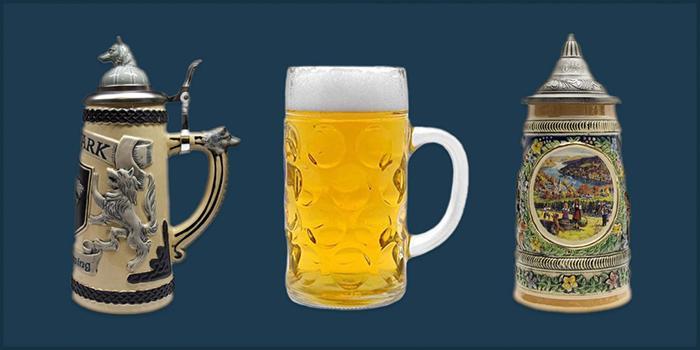
A beer stein does not have a single universal volume. The most commonly encountered steins hold either 0.5 liters (approximately 16.9 oz) or 1 liter (approximately 33.8 oz). However, steins exist across a range from as small as 0.06 liters (barely more than a shot glass) up to novelty versions that hold 2 liters, 5 liters, or even more as decorative or collector’s pieces.
Here is a clear breakdown of the most common stein sizes and how they translate into the fluid ounces Americans are most familiar with:
| Stein Volume | Fluid Ounces (approx.) | Closest U.S. Reference |
|---|---|---|
| 0.3 L | 10.1 oz | Slightly less than a standard can |
| 0.5 L (“Halbe”) | 16.9 oz | Just over a U.S. pint |
| 1.0 L (“Mass” / “Masskrug”) | 33.8 oz | Nearly 2.1 U.S. pints |
| 1.5 L | 50.7 oz | Over 3 U.S. pints |
| 2.0 L | 67.6 oz | Over 4 U.S. pints |
For comparison, the standard American pint glass holds 16 fluid ounces, which is actually slightly less than the German half-liter stein. So if you’ve ever picked up a German stein at a brewery and felt like you got more beer than usual, you weren’t imagining it.
Understanding the “Mass”: The Iconic One-Liter Oktoberfest Stein
If you picture Oktoberfest in your mind, the image that appears is almost certainly someone hoisting a one-liter Masskrug overflowing with golden lager. The word Maß (pronounced roughly “MAHSS”) is a German unit of measure that refers specifically to exactly one liter of beer, most commonly associated with Bavaria and Austria.
The modern Masskrug is slightly larger than 1 liter to the brim. That’s intentional. German beer culture measures to a certified fill line, not to the rim of the glass. The space above that line is reserved for the Schaum, the foamy head, which in German brewing tradition is considered an essential part of the pour, not wasted space. For a 1-liter dimpled Oktoberfest mug, that foam zone is roughly the top 1.5-inch smooth band above the dimpled portion of the glass.
This is a meaningful contrast to how Americans typically think about glassware. In the U.S., a pint glass holds exactly one pint to the very top. German stein manufacturers build extra capacity above the fill line so you always get your full liter of actual beer, even with a proper head on it.
A full one-liter dimpled glass Masskrug, filled to the line, weighs approximately 5 pounds (about 2.25 kg). The glass alone weighs around 3 pounds. That’s a serious piece of equipment, and it’s the reason Steinholding, the sport of holding a full one-liter stein outstretched at arm’s length for as long as possible, is genuinely grueling.
A Brief, Fascinating History of the Beer Stein
Understanding what a stein is makes the question of how much it holds a lot richer. The word “stein” itself is borrowed from the German Stein, meaning “stone,” derived from the older compound Steinzeugkrug, which translates to “stoneware jug.” In standard modern German, Germans don’t actually use the word stein for their mugs. They say Krug, Humpen, or, in Bavaria and Austria, Seidel. At Oktoberfest, the official term is Maßkrug. The word “stein” became the English-language label through 19th-century American usage, first documented in print around 1855.
The Bubonic Plague Connection You Didn’t Expect
Here’s a historical fact that genuinely surprises most people: the beer stein as a lidded vessel owes its existence to the Black Death.
Between approximately 1340 and 1380, the bubonic plague killed over 25 million Europeans, roughly one third of the continent’s entire population. The subsequent fly infestations, born from hundreds of thousands of unburied corpses, were catastrophic. By the early 1500s, several German principalities had passed laws requiring that all food and beverage containers be covered to protect consumers from disease-carrying insects.
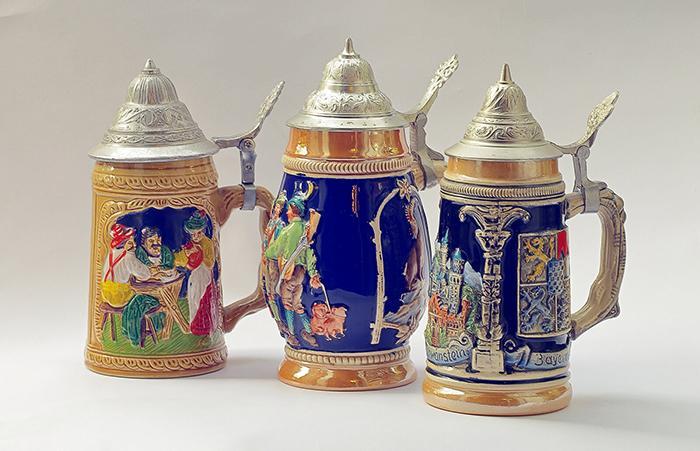
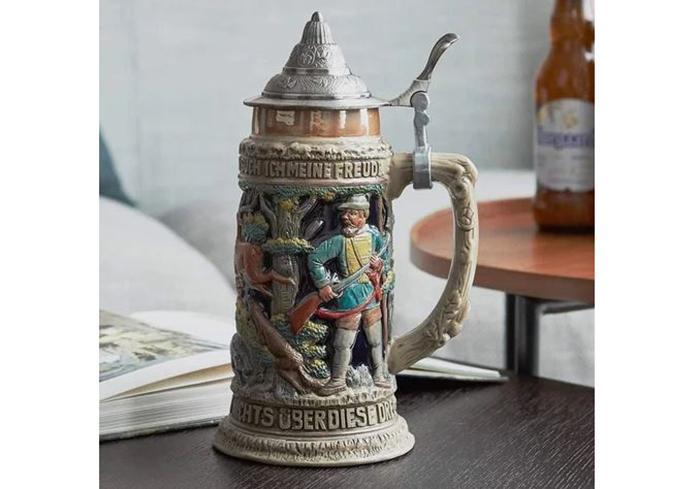
The common mug had to be modified accordingly. The solution was brilliant in its simplicity: a hinged pewter lid with a thumblift, allowing the drinker to flip the cover open and drink with one hand while keeping the beer sealed between sips. This design became the hallmark of the traditional German beer stein and is what technically distinguishes a stein (lidded) from a simple mug (open top) to this day.
Germany’s response to the plague went further than just lids. The country passed a sweeping series of sanitation laws, including one of the most famous in brewing history: the Reinheitsgebot, the German Beer Purity Law, mandating that beer could only be brewed using water, hops, yeast, and cereals. These regulations dramatically improved the taste of German beer, increasing average daily beer consumption in many places to roughly two liters per person.
Stoneware, Pewter, and the Rise of Craftsmanship
The demand for covered beverage containers also accelerated a major leap in materials science. German potters began experimenting with raising the firing temperature of clay from around 900°F to above 2,200°F. The result was stoneware, a vitrified, non-porous, chip-resistant material far superior to the earthenware vessels that came before. Stoneware steins could be safely used, cleaned, and reused, and because they were expensive to produce, they quickly became status symbols.
By the 17th century, beer stein artistry was flourishing. Craftsmen applied intricate carvings, cobalt blue glazes, relief scenes depicting biblical stories, hunting motifs, mythological figures, and household crests. A stein was no longer merely a drinking vessel. It was a declaration of social standing.
Read More : How To Boil Brats Without Beer Updated 10/2026
The most traditional production region is the Kannenbäckerland in the Westerwald area of Germany, which has been crafting steins for centuries and remains revered among collectors worldwide.
Oktoberfest and the Standardization of the One-Liter Stein
Oktoberfest itself began not as a beer festival but as a royal wedding party. On October 12, 1810, Crown Prince Ludwig of Bavaria married Princess Therese of Sachsen-Hildburghausen. Instead of a private celebration, Ludwig opened the gates and invited the people of Munich to a free party in a field, which was renamed Theresienwiese (Therese’s Meadow) in her honor. The field is still called Wiesn today, and that’s the name real Münchners use for the festival.
By 1819, the city had taken over planning and made Oktoberfest an annual tradition. Over 6 million people now attend each year, and estimates suggest visitors collectively drink over 6 million liters of beer during the festival. To ensure fairness and prevent fraud, early Oktoberfest regulations required beer to be served in standardized one-liter mugs with a certified fill line. The tradition stuck, and the one-liter Masskrug became the iconic vessel of the festival.
Stein Materials: What’s Holding Your Beer?
The material a stein is made from affects not only its appearance and value but also the temperature and taste of the beer inside it. Here’s a breakdown of the major materials you’ll encounter:
Stoneware (Steinzeug)
This is the original and most traditional material. Fired at extremely high temperatures (around 1,200 to 1,400°C), stoneware vitrifies into a dense, non-porous surface. It keeps beer cool longer than glass because it insulates the liquid from ambient heat. Most authentic German steins sold as souvenirs or collectibles are stoneware. The thick walls also make a deeply satisfying clunk when you set one down on a table.
Glass (Glas)
Since the introduction of glass to Oktoberfest mugs in 1892, glass has been the standard serving vessel in German beer gardens and festival tents for hygienic reasons. Glass steins are open-top, lidless, and typically come in the familiar 0.5-liter and 1.0-liter sizes. They let you admire the color and clarity of the beer, which matters to a lot of drinkers.
Pewter (Zinn)
Pewter was historically both the material of choice for lids and for the stein body itself, particularly in England. Today, pewter steins are mostly found in collector circles or as ceremonial pieces. Antique pewter steins with their distinctive domed lids and finials are among the most historically significant items in stein collecting.
Porcelain and Ceramic
Porcelain steins became popular in the 18th century and allowed for exceptionally detailed hand-painted decoration. Character steins, shaped like animals, people, or objects, were often made from porcelain molds. These are highly collectible today and can command significant prices at auction.
Crystal Glass
For the premium end of the market, crystal steins offer extraordinary visual clarity and a satisfying weight. These are typically gift or display pieces rather than everyday drinking vessels.
The Real-World Numbers: Comparing Stein Sizes to What Americans Know
Because most Americans measure their drinks in ounces or pints rather than liters, here’s a practical translation table that puts stein volumes into context:
| Stein | Volume | Equals This Many… |
|---|---|---|
| 0.3 L (small/Pilsner) | 10.1 oz | 0.84 cans of beer (12 oz) |
| 0.5 L (half-liter, “Halbe”) | 16.9 oz | 1.06 American pint glasses |
| 1.0 L (Mass/Masskrug) | 33.8 oz | 2.1 American pint glasses OR 2.8 standard cans |
| 2.0 L (Das Boot, large) | 67.6 oz | 4.2 American pint glasses OR 5.6 standard cans |
For context: if you’re at a bar and you order a pint, you’re getting 16 ounces. If you’re handed a half-liter German stein at an Oktoberfest event, you’re getting 16.9 ounces, essentially a pint plus an extra splash. If someone slides you a one-liter Mass, you’re looking at roughly two and a half times a standard can of beer in a single vessel.
One more important detail for American drinkers: the standard 12-ounce bottle or can of beer in the U.S. is only about 71% of a half-liter stein. When someone says “I drank three steins at Oktoberfest,” that’s equivalent to consuming over 6 cans of beer. The scale is real.
How Pouring Technique and Beer Style Affect What You Actually Drink
Even if you know a stein holds 16.9 or 33.8 ounces, you’re not necessarily drinking that full amount. Two factors influence how much liquid beer ends up in the glass versus foam:
The Beer’s Foam Profile
Different beer styles behave very differently when poured:
- Lagers (including Märzen and Festbier, the classic Oktoberfest styles) tend to produce a moderate, manageable head. You’ll generally get close to the full volume of liquid beer.
- Wheat beers (Hefeweizen) foam aggressively, especially if poured quickly. A proper German pour into a tall 0.5-liter Weizen glass requires significant head space, and some foam inevitably displaces liquid.
- Stouts and porters create a thick, creamy nitrogen head that takes up meaningful volume in the glass. The foam is intentional and considered part of the experience.
A general rule of thumb: plan for the head to account for about 10 to 15 percent of your stein’s listed capacity unless you’re a very skilled pourer or you’re letting a German barkeep handle it.
The Pouring Technique Itself
A proper pour into a stein follows a straightforward method. Tilt the glass to about 45 degrees at the start to reduce turbulence, let the beer flow down the inside wall. As the glass fills, gradually straighten it until the pour is vertical. Aim to finish with about one inch of foam head, which will help release aromas and keep the beer from going flat too quickly. Pouring ice cold beer into an ice cold stein further reduces excess foaming.
For larger steins (1 liter and above), the slow pour is even more critical. Moving too fast creates a cascade of foam that can overfill the glass before you’ve gotten your full liter of actual beer.
The Stein vs. the Mug vs. the Pint: What’s the Difference?
These three terms are used interchangeably in American bars and restaurants, but they actually describe distinct vessels:
The Beer Stein is, strictly speaking, a lidded stoneware drinking vessel with a handle, originating in Germany. The lid is the defining feature. In casual modern usage, “stein” often refers to any large, handled ceramic or glass beer mug, regardless of whether it has a lid.
Read More : Is There Formaldehyde In Budweiser Beer Updated 10/2026
The Beer Mug is a handled glass or ceramic cup, typically ranging from 10 to 17 ounces in standard pub versions. It does not have a lid. The thick walls help maintain cold temperature and withstand enthusiastic Prost! toasts.
The American Pint Glass is a simple, conical, 16-ounce glass with no handle. It was originally designed as a cocktail shaker, not a beer glass, which is why many serious craft beer drinkers actually dislike it. It doesn’t maintain temperature well, and the wide mouth releases aromas quickly.
The Difference in Practice: A one-liter German Masskrug holds more than twice what an American pint glass holds. When you order a pint at a bar, you’re getting approximately half the volume of the classic Oktoberfest stein. That’s not a complaint about pints, just a useful calibration.
Steinholding: When the Stein Becomes a Sport
If you’ve ever seen someone hold a full one-liter stein outstretched at arm’s length, you’ve witnessed Masskrugstemmen, known in the U.S. as Steinholding. This is a legitimate sport with official competitions, governing bodies, and records.
A filled 1-liter Masskrug weighs approximately 5 pounds, with the glass alone contributing about 3 pounds. Competitors hold the stein parallel to the ground with a straight arm, and the last person with good form wins. According to the U.S. Steinholding Association, the current U.S. Men’s National Record stands at 29 minutes and 0 seconds, set by Cody Bane at the 2025 U.S. Steinholding Association National Championships. The Women’s National Record is 6 minutes and 10 seconds.
Without training, an average person can typically hold a full stein for about 3 to 5 minutes for men and 1 to 3 minutes for women. The sport, while rooted in Bavarian tradition, has developed a robust following across the United States with sanctioned venues, state championships, and national finals.
Collecting Beer Steins: Where Size Meets Value
Beer stein collecting is a serious hobby in the United States, Germany, Japan, and across the world. The range in collectible value is enormous:
- Mass-produced modern souvenir steins can be found for $20 to $100 at German import shops, Oktoberfest events, and online retailers.
- Early 20th-century Art Nouveau-style steins typically fetch a few hundred dollars at auction.
- Rare World War II-era military regimental steins can command over $1,000 depending on condition and provenance.
- Antique 18th-century sterling silver steins have sold for over $2,200 at recent auctions.
- Antique 32-liter novelty steins (yes, those exist), standing five feet tall, have been priced around $1,300 even decades ago.
Organizations like Stein Collectors International (SCI) connect enthusiasts, authenticate pieces, and organize events. If you’re buying an authentic German stein, note that the Merchandise Marks Act of 1887 required all authentic German-made steins to be marked “Made in Germany,” making post-1887 provenance easier to confirm.
The most prestigious modern manufacturers include King-Werk, Zöller and Born, and Thewalt, all of which continue centuries-old craft traditions in Germany.
Choosing the Right Stein for Your Drinking Style
With all the options available, here’s a practical guide to picking the right stein for different situations:
For everyday casual drinking at home: A 0.5-liter glass stein or heavy ceramic mug is ideal. It holds a satisfying amount (just over a pint), keeps your beer cold, and doesn’t require a two-handed lift mid-sip.
For Oktoberfest parties and group celebrations: The 1-liter Masskrug, either glass or dimpled stoneware, is the authentic choice. It reduces how often you need to refill and sets the right festive tone. The handle is essential for carrying multiple mugs at once.
For craft beer tasting: A 0.3-liter smaller stein or tulip-style glass lets you try multiple styles without committing to a massive pour. Many craft breweries now stock half-liter handled steins that bridge tradition and practicality.
For collecting or gifting: Stoneware steins with pewter lids and hand-applied decorations are the gold standard. Look for pieces from the Westerwald region of Germany, or from the established manufacturers listed above.
For drinking games and group events: The Das Boot (beer boot), which typically holds 0.5 to 2 liters in a boot shape, is a fun alternative with its own Bavarian cultural tradition. Drinking from a boot glass without spilling on yourself when the air pocket in the toe suddenly shifts the liquid is genuinely a learned skill.
A Few Things You Didn’t Know About Beer Stein Culture
Because the history goes deep, here are a few facts that tend to surprise even dedicated beer drinkers:
- Average beer consumption in 16th-century Germany reportedly reached about two liters per person per day in many towns, following the post-plague sanitation reforms that made German beer significantly safer and better-tasting.
- The Hofbräuhaus in Munich, arguably the world’s most famous beer hall, can seat up to 3,000 people and sells its own imprinted one-liter glass Masskrugs as souvenirs.
- Stoneware steins keep beer cooler longer than glass because the thick ceramic walls insulate the beer from ambient temperature. That’s not just historical trivia; it’s a genuinely practical advantage on a hot day.
- An empty 1-liter Masskrug weighs 1.3 kilograms (about 2.9 lbs) and, according to a study by physicist Erich Schuller at Ludwig Maximilian University Munich, can produce a force of 8,500 newtons in a blow, far exceeding the 4,000 newtons required to fracture a human skullcap. Treat your stein with respect.
- The “Das Boot” beer boot glass became popular in the U.S. partly through World War II veterans who encountered the tradition in Bavarian beer culture and brought the novelty home.
The Bottom Line on Stein Volume
So, how much beer is in a stein? Here’s your cheat sheet:
- A traditional half-liter stein holds about 16.9 oz, which is slightly more than an American pint.
- The classic one-liter Oktoberfest Masskrug holds about 33.8 oz, roughly equivalent to two and a half cans of beer or 2.1 American pints.
- Steins range from tiny 2-oz collectible sizes to novelty giants holding several liters.
- Germans measure to a fill line, not the brim, so actual beer capacity is the stated volume. The extra space is for foam.
- Material matters: stoneware keeps beer cooler, glass lets you see it, and pewter is mostly for history and aesthetics.
Raise Your Stein, Not Your Questions
The next time you’re handed a stein at a festival, a brewery, or someone’s backyard, you’ll know exactly what you’re holding, how much is in it, and why it’s shaped the way it is. From a public health response to one of history’s deadliest pandemics to the centerpiece of a global beer tradition that draws millions every year, the stein is one of those objects that’s quietly been part of civilization for longer than the United States has existed.
Pick the size that fits your occasion. Pour it right. Leave room for the head. And say Prost.
Sources: https://chesbrewco.com
Category: Beer