You’ve been there. You throw a six-pack in the freezer to get it ice-cold fast, then completely forget about it. Twenty minutes later you’re back and greeted by a slushy, potentially exploded mess. Or maybe it’s the dead of winter in Chicago and you left a case of Bud Light in the trunk of your car overnight. Either way, you’re suddenly wondering: at exactly what temperature does beer freeze?
The answer is more interesting than you might think. It’s not just a single number. It depends on what’s in your beer, how it’s packaged, and the science of how alcohol and water interact with cold. Whether you’re a casual weekend tailgater, a craft beer enthusiast, or someone who just wants to make sure the party cooler doesn’t turn into an ice sculpture, this guide covers everything you need to know.
You Are Watching: What Temp Does Beer Freeze Updated 10/2026
The Short Answer: Beer Freezes Around 28°F
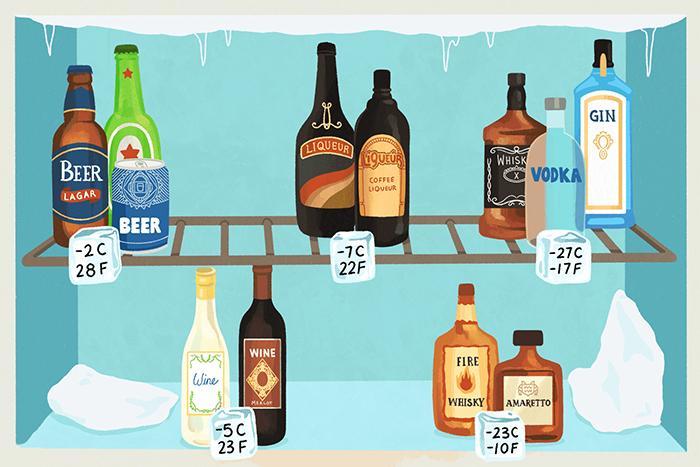
Most standard American beers, those in the 4% to 6% ABV (alcohol by volume) range, freeze at approximately 28°F (-2°C). That’s four degrees colder than the freezing point of plain water at 32°F (0°C).
Why doesn’t beer freeze at the same temperature as water? Because beer is not just water. It’s a complex mixture of water, ethanol (alcohol), dissolved carbon dioxide, residual sugars, proteins, minerals, and hop compounds. Each of these lowers the freezing point below what pure water would experience, a chemistry principle known as Freezing Point Depression (FPD).
Alcohol, specifically ethanol, is the most powerful driver of this effect. Pure ethanol doesn’t freeze until it hits a bone-crushing -173.2°F (-114.3°C). Your home freezer tops out around 0°F to -10°F, so pure alcohol is completely safe in there. But beer is not pure ethanol. On average, beer is 90% to 95% water by volume, which means the water content is the dominant factor, and water absolutely freezes.
The more alcohol your beer contains, the lower its freezing point drops. A standard Bud Light or Coors Light will freeze faster than a big, boozy Imperial Stout or a double IPA.
How ABV Changes the Freezing Point: A Complete Breakdown
This is where the science gets practical. A general rule of thumb in brewing science is that for every 1% increase in ABV, the freezing point decreases by just over 1 degree Fahrenheit. The actual formula used by brewers goes deeper:
Freezing Point (°C) = (-0.42 × Alcohol by Weight%) + (0.04 × Original Gravity in °Plato) + 0.2
That formula accounts for both the alcohol content and the residual sugars in the finished beer. You don’t need to memorize it. What matters is the real-world outcome, which is laid out in the table below.
Beer Freezing Points by ABV
| Beer Style / Type | Typical ABV | Freezing Point (°F) | Freezing Point (°C) |
|---|---|---|---|
| Non-alcoholic beer | 0–0.5% | ~32°F | ~0°C |
| Light lager (Bud Light, Coors Light, Miller Lite) | 3.2–4.2% | ~29–30°F | ~-1.5°C |
| Standard lager/pale ale (Budweiser, Corona, Heineken) | 4.5–5.5% | ~28°F | ~-2°C |
| Session IPA | 4–5% | ~28–29°F | ~-2°C |
| Amber ale / Märzen | 5–6% | ~27–28°F | ~-2.5°C |
| IPA (standard) | 6–7% | ~26–27°F | ~-3°C |
| Double IPA / Strong Ale | 8–10% | ~24–25°F | ~-4°C |
| Imperial Stout / Barleywine | 10–14% | ~20–23°F | ~-6 to -7°C |
| Eisbock / Extreme High-ABV | 14%+ | Below 20°F | Below -7°C |
Note: Sugar content, carbonation level, and dissolved minerals will cause slight variations within each category.
For context, Corona Extra has an ABV of 4.6%, which means it freezes at approximately 28.5°F (-1.9°C). Leave it in a cold car overnight in Minnesota and you might come back to a beer-cicle.
The Science Behind Beer Freezing: Freezing Point Depression
When you add any solute (a dissolved substance) to water, you lower the temperature at which that water will freeze. This phenomenon, called Freezing Point Depression, is why cities spread salt on icy roads. Salt dissolved in water lowers the freezing point, keeping the water liquid at temperatures where it would otherwise become ice.
Beer works on the same principle. Alcohol, sugars, proteins, and mineral salts all act as solutes. Each one contributes to pushing the freezing point downward from 32°F. Alcohol is by far the biggest contributor, but residual sugars from the brewing process also play a meaningful role.
This is why a heavily hopped, malt-forward Imperial Stout with complex sugars and high alcohol stays liquid at temperatures that would turn a thin, low-ABV light lager into a slush. And it’s also why alcohol-free beer, containing almost no alcohol and minimal residual sugars, freezes at nearly the same temperature as tap water.
The Role of Carbonation and Pressure
Here’s something most people don’t know: the dissolved CO₂ (carbonation) inside a sealed can or bottle actually lowers the freezing point slightly and helps maintain the beer in liquid form because of the internal pressure. According to physics, increased pressure raises the internal temperature of a container. This is the same principle as a CO₂ fire extinguisher: liquid CO₂ is held in the bottle by pressure, and the moment pressure is released, the temperature drops dramatically.
This means a sealed, pressurized can of beer can actually withstand slightly colder temperatures than its open equivalent. However, once you pop that cap, the pressure drops, and if the beer is already right at the edge of freezing, it may instantly crystalize in your hand.
How Long Does It Take for Beer to Freeze?
Knowing the temperature at which beer freezes is only half the picture. How quickly it gets there matters just as much, especially if you’re trying to use the freezer as a quick-chill strategy.
Several variables affect the speed of freezing:
Starting temperature of the beer. A warm beer at room temperature (72°F) takes longer to reach freezing than a beer that’s already been refrigerated to 38°F.
Freezer temperature. Most home freezers run at 0°F (-18°C). The colder the freezer, the faster your beer gets there.
Read More : How To Pour A Beer From A Tap Like a Pro Updated 10/2026
Container material. Aluminum cans conduct cold faster than glass bottles. A can will chill and potentially freeze faster than a bottle of the same size.
Beer ABV. Light beers with lower ABV, such as a 3.2% session lager, can freeze in as little as 2 to 3 hours in a standard freezer. A stronger craft beer in the 8–10% ABV range may take 5 to 6 hours or more.
The Quick-Chill Rule of Thumb
If you’re trying to chill a beer quickly without freezing it, here are some reliable time guidelines:
- 20 minutes in the freezer (room-temp beer in a can): Gets it cold but not frozen, if you remember to take it out.
- 40 minutes in the freezer: A chilled glass or mug will be frost-coated and ready for pouring.
- 60 minutes in the freezer: A room-temperature beer reaches approximately 40°F, which is the ideal serving temperature for most commercial lagers and craft pale ales.
- More than 90 minutes: You’re gambling with fate. Slush is possible, explosion is not out of the question.
The fastest method without risking a frozen mess: wrap the beer can or bottle in a wet paper towel and place it in the freezer. The moisture conducts cold far more efficiently than air. A room-temperature beer can go from warm to properly chilled in as little as 10 minutes this way. Set a timer. Every time.
What Actually Happens When Beer Freezes
Understanding the physics of frozen beer helps explain why it causes so many problems.
Water Expands, Alcohol Doesn’t (Yet)
Beer is primarily water. When the temperature drops below approximately 28°F, the water molecules in the beer slow down and organize into ice crystals. Water expands by about 9% in volume when it freezes. That expansion has nowhere to go inside a sealed can or bottle, so it pushes outward.
The alcohol in the beer, with its dramatically lower freezing point, remains liquid. This creates an interesting separation: as ice crystals form, the remaining liquid portion becomes increasingly concentrated in alcohol and other solutes. The freezing point of this concentrated liquid keeps dropping as more and more water freezes out, which is actually the principle behind the traditional German Eisbock beer style. Brewers freeze the beer intentionally and then remove the ice, concentrating the alcohol and flavor into a stronger, richer brew.
Why Cans and Bottles Explode
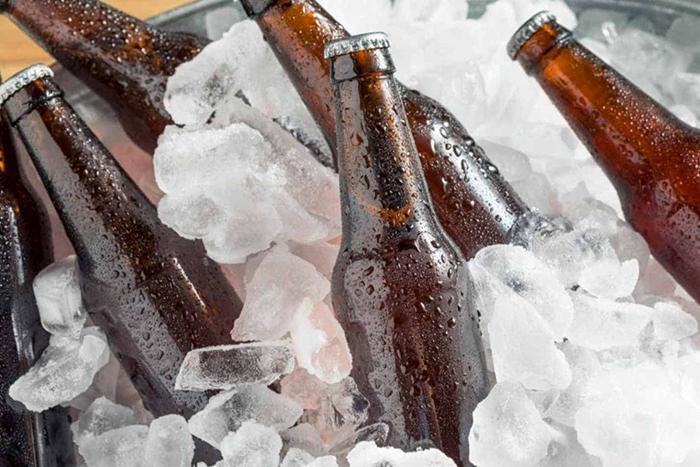
As water in the beer expands into ice, the pressure inside the sealed container builds. Glass bottles are rigid and non-flexible, making them especially prone to shattering, sending sharp fragments across your freezer. Aluminum cans are more forgiving due to slight flexibility, but they will bulge, deform, and ultimately burst if left long enough. The result: a frozen beer explosion that coats the inside of your freezer and ruins the other food in there.
Safety note: If you discover a glass beer bottle that has frozen, do not attempt to thaw it by handling it or running it under warm water. Even a hairline crack in frozen glass can cause it to shatter suddenly. Discard it carefully.
Carbonation Takes a Hit
When beer freezes, the CO₂ dissolved in the beer is disrupted. Ice crystal formation creates tiny nucleation sites in the liquid that cause CO₂ to migrate out of solution. In a sealed container, this gas is trapped and builds pressure. When you eventually open the thawed beer, you may get a violent gush (a phenomenon known as gushing), or you may find the beer is noticeably flat.
Blind taste tests conducted by Beer Syndicate found that tasters could correctly identify a frozen-and-thawed beer from an untouched beer 75% of the time, primarily based on reduced carbonation. The effect was described as “slightly duller,” with carbonation levels estimated to have dropped by approximately 20 to 25%. However, researchers at Brülosophy found in a separate experiment that when tasters couldn’t use carbonation level as a direct cue, they struggled to reliably distinguish frozen-thawed pale lager from unaltered beer, suggesting the flavor impact varies by beer style.
What Happens to the Flavor
Freezing accelerates the aging process in beer. The freeze-thaw cycle causes proteins in the beer to coagulate and settle out, creating visible cloudiness or floating flakes once the beer thaws. This is called chill haze, and while it is primarily cosmetic, it signals that the beer’s delicate compounds have been disrupted.
Hop aroma compounds, which are volatile and fragile, can escape when carbonation rushes out during freezing. This means hoppy beers, especially Hazy IPAs and fresh-hopped ales, are the most vulnerable to flavor degradation from freezing. Their delicate fruity and citrusy esters don’t survive the process well. Clear lagers and pilsners, by contrast, tend to be more resilient.
Popular American Beers and Their Approximate Freeze Points
Here’s how some of the most popular beers Americans drink every day stack up when the temperature drops:
| Beer Brand | ABV | Approximate Freeze Point |
|---|---|---|
| Bud Light | 4.2% | ~29°F (-1.7°C) |
| Coors Light | 4.2% | ~29°F (-1.7°C) |
| Miller Lite | 4.2% | ~29°F (-1.7°C) |
| Budweiser | 5.0% | ~28°F (-2.2°C) |
| Corona Extra | 4.6% | ~28.5°F (-1.9°C) |
| Heineken | 5.0% | ~28°F (-2.2°C) |
| Sierra Nevada Pale Ale | 5.6% | ~27.5°F (-2.5°C) |
| Sam Adams Boston Lager | 5.0% | ~28°F (-2.2°C) |
| Dogfish Head 60 Minute IPA | 6.0% | ~27°F (-2.8°C) |
| Lagunitas IPA | 6.2% | ~26.5°F (-3.1°C) |
| Blue Moon Belgian White | 5.4% | ~27.5°F (-2.5°C) |
| Guinness Draught | 4.2% | ~29°F (-1.7°C) |
| Founders KBS (Imperial Stout) | 11.2% | ~22°F (-5.6°C) |
Figures are approximate based on ABV-based freezing point calculations.
Storing Beer in Cold Weather: Practical Scenarios
The Car Trunk Problem
If you live in the northern United States, the Midwest, or anywhere temperatures regularly drop below 30°F in winter, leaving beer in your car overnight is a real gamble. A trunk is not insulated, and outside air temperatures in cities like Minneapolis, Chicago, Denver, and Detroit routinely plunge well below 28°F from November through March.
A 12-pack of Bud Light left in a Chicago car overnight when the temperature is 15°F? Those cans are almost certainly frozen solid by morning.
The best practice: never leave beer in an unheated vehicle overnight in cold-weather climates. If you must transport beer in winter, keep it in the cabin of the car, not the trunk.
The Outdoor Cooler at a Winter Party
Tailgating in January? Keeping beer in an outdoor cooler when it’s 25°F outside will actually freeze your beer rather than chill it. The solution is counterintuitive: add a small amount of warm water to your outdoor cooler to bring the temperature up to the safe chilling zone, roughly 30°F to 34°F.
Beer Left Outside Overnight in Cold States
In places like Minnesota, Wisconsin, Vermont, and upstate New York, people sometimes use their garages, porches, or outdoor storage areas as natural refrigerators in winter. This works reasonably well when temperatures hover between 34°F and 40°F. But the moment overnight temperatures dip below 28°F, your beer is in danger.
A good rule: if the weather app on your phone shows overnight lows below 30°F, bring the beer inside. Especially if it’s in glass bottles.
Can You Drink Frozen Beer After It Thaws?
The short answer is: yes, if the container is still intact. Whether you should depends on a few things.
If the can or bottle has not burst, has no cracks, and the seal is unbroken, the beer is physically safe to drink once it has completely thawed. The alcohol content is unchanged, and the beer poses no health risk. However, expect a noticeably flatter pour and potentially duller flavors, especially in carbonation-forward or hop-forward styles.
The Right Way to Thaw Frozen Beer
Rushing the thaw is how things go wrong. The most important rule: never use hot water, a microwave, or a stovetop to speed up the process. Rapid temperature change will cause thermal shock in glass bottles, and a microwave creates hot spots that can cause a sealed container to explode violently.
Read More : Are Johnsonville Brats Gluten Free Updated 10/2026
The correct method:
- Move from the freezer to the refrigerator. Allow the beer to thaw slowly at refrigerator temperature (35–40°F). This takes 12 to 24 hours but preserves the most quality and avoids container damage.
- Do not agitate. Shaking or rolling a partially-thawed beer will cause any remaining dissolved CO₂ to rush out of solution once you open it, creating a gusher. Keep it perfectly still.
- If you need to speed things up, place the sealed beer in a container of cold (not warm) water and change the water every 15 to 30 minutes. Cold water thaws beer faster than refrigerator air without the shock risk.
- Inspect before opening. Check for any bulging, deformation, or cracks before you open it. A bulging can is under significant internal pressure. Open slowly over a sink.
Ideal Beer Serving Temperatures: The Other Side of the Coin
Knowing when beer freezes is just as important as knowing the ideal temperatures for drinking it. Not all beer should be served ice-cold. In fact, serving many craft styles too cold kills the flavor just as surely as freezing does.
| Beer Style | Ideal Serving Temp (°F) | Ideal Serving Temp (°C) |
|---|---|---|
| Light lager, Pilsner | 35–40°F | 2–4°C |
| Kölsch, Wheat beer | 40–45°F | 4–7°C |
| American Pale Ale, IPA | 45–50°F | 7–10°C |
| Porter, Stout | 50–55°F | 10–13°C |
| Belgian Ales | 54–61°F | 12–16°C |
| Imperial Stout, Barleywine | 55–60°F | 13–16°C |
| Lambic / Sour Ale | 50–55°F | 10–13°C |
Serving a Guinness Draught ice-cold actually mutes the roasted coffee and chocolate notes that make it special. Conversely, a light Coors Light served at 50°F tastes uninspiring and slightly stale. Temperature is not just science, it’s craft.
The Myth That Alcohol Doesn’t Freeze (and Why Beer Is Different)
One of the most persistent myths in American drinking culture is that alcohol doesn’t freeze. This misunderstanding comes from the observation that bottles of vodka, whiskey, and rum stored in home freezers never seem to freeze. That’s largely true in practice, but not because alcohol doesn’t freeze: it’s because home freezers simply don’t get cold enough to freeze high-proof spirits.
Distilled spirits bottled at 80 proof contain 40% alcohol by volume, which means the ethanol-water mixture freezes at approximately -13.9°F (-25.5°C). A standard American home freezer runs at 0°F (-18°C), which is cold enough to chill vodka beautifully but not cold enough to freeze it.
100-proof liquors (50% ABV) won’t freeze until -28.3°F (-33.5°C), which is well beyond what any household freezer achieves.
Beer, however, is only 4–6% alcohol. That’s not nearly enough ethanol to lower the freezing point much below 28°F, a temperature your freezer surpasses easily. The practical takeaway:
- Vodka in the freezer: Totally safe indefinitely.
- Beer in the freezer: Will freeze within 1 to 3 hours depending on ABV.
- Wine in the freezer: Somewhere in between (most wines are 11–14% ABV, freezing around 22–25°F).
- Liqueurs in the freezer: Vary widely due to sugar content; some like Baileys Irish Cream can freeze or curdle.
Eisbock and the Art of Intentional Freezing
Not all frozen beer is a disaster. In Germany, brewers have been deliberately freezing beer for centuries to create a style known as Eisbock (“ice bock”). The process works by partially freezing a strong bock beer and then removing the ice that forms. Because water freezes first (at a higher temperature than alcohol), the ice extracted is mostly water. What remains is a liquid that is more concentrated in alcohol, residual sugars, and flavor compounds.
Traditional Eisbock clocks in at 9% to 14% ABV, and the style is known for its intensely rich malt character, dried fruit flavors, and warming finish. Samuel Adams Utopias, one of the strongest commercially available American beers, uses a related freeze-concentrating technique and reaches an extraordinary 28% ABV.
This is freeze distillation, and while home brewing variations of it exist in a legal gray area in some states, it demonstrates that controlled, intentional freezing can actually enhance a beer if you know what you’re doing.
Tips to Prevent Your Beer from Accidentally Freezing
Prevention is far better than dealing with a frozen mess or a flat, ruined beer. Here’s what works:
Use a refrigerator, not a freezer, for long-term storage. The sweet spot is between 35°F and 40°F (1.7°C to 4.5°C). This keeps beer perfectly cold for drinking while staying safely above the freeze threshold.
Set a timer every time you use the freezer to chill beer. Ten to fifteen minutes for a can that started at refrigerator temperature. Twenty minutes max for a room-temperature can. After that, you’re in the danger zone.
Don’t store beer in unheated outdoor spaces below 30°F. A garage in winter sounds like a perfect beer cave until it hits 15°F in January and your entire supply explodes overnight.
Choose higher-ABV beers for cold-weather outdoor events. If you’re skiing, ice fishing, or tailgating in sub-freezing temps, a 7% to 8% craft beer will hold up significantly longer before freezing than a 4.2% light lager.
Buy insulated can holders (koozies) for outdoor use. They provide meaningful thermal insulation and can add several degrees of protection in borderline cold conditions.
Know your freezer’s actual temperature. Many home freezers run colder than their dial suggests. A simple freezer thermometer ($5 to $10) takes all the guesswork out.
A Note on Wine and Cocktails in Cold Temperatures
Since many of you enjoy more than just beer, a quick look at how wine and cocktails handle the cold is worth your time.
Wine typically contains 11% to 14% ABV, which puts its freezing point in the range of 22°F to 25°F (-5°C to -3.9°C). That’s meaningfully lower than standard beer. A bottle of Cabernet Sauvignon left in a car overnight at 20°F will likely freeze and potentially push the cork out or crack the bottle due to expansion. Sparkling wines like Champagne or Prosecco are even more vulnerable because the dissolved CO₂ adds pressure complexity.
Cocktail mixers and ready-to-drink (RTD) canned cocktails vary dramatically. A canned margarita at 12.5% ABV is fairly resistant to freezing, sitting around 22°F. A low-ABV hard seltzer at 5% will freeze at about the same temperature as a standard beer.
The rule applies equally across all of these: more alcohol means a lower freezing point, and more water means a higher risk of freezing in typical winter temperatures.
Conclusion
There’s a certain pleasure in knowing the exact science behind something as simple and satisfying as a cold beer. The next time you’re staring at a frozen can of Bud Light or trying to figure out whether it’s safe to leave a case of Sierra Nevada in your car during a Wisconsin snowstorm, you’ll know exactly what’s happening and why.
28°F is the number to remember for most American beers. Everything above that is safe territory. Everything below is a race against time, chemistry, and the inexorable expansion of freezing water.
More than just a practical number, that 28°F tells a broader story: that beer is alive with chemistry, that the same forces shaping the flavor in your glass also determine whether your car trunk becomes a crime scene on a January morning. Respect the cold. Respect the craft. And always, always set a timer.
Sources: https://chesbrewco.com
Category: Beer